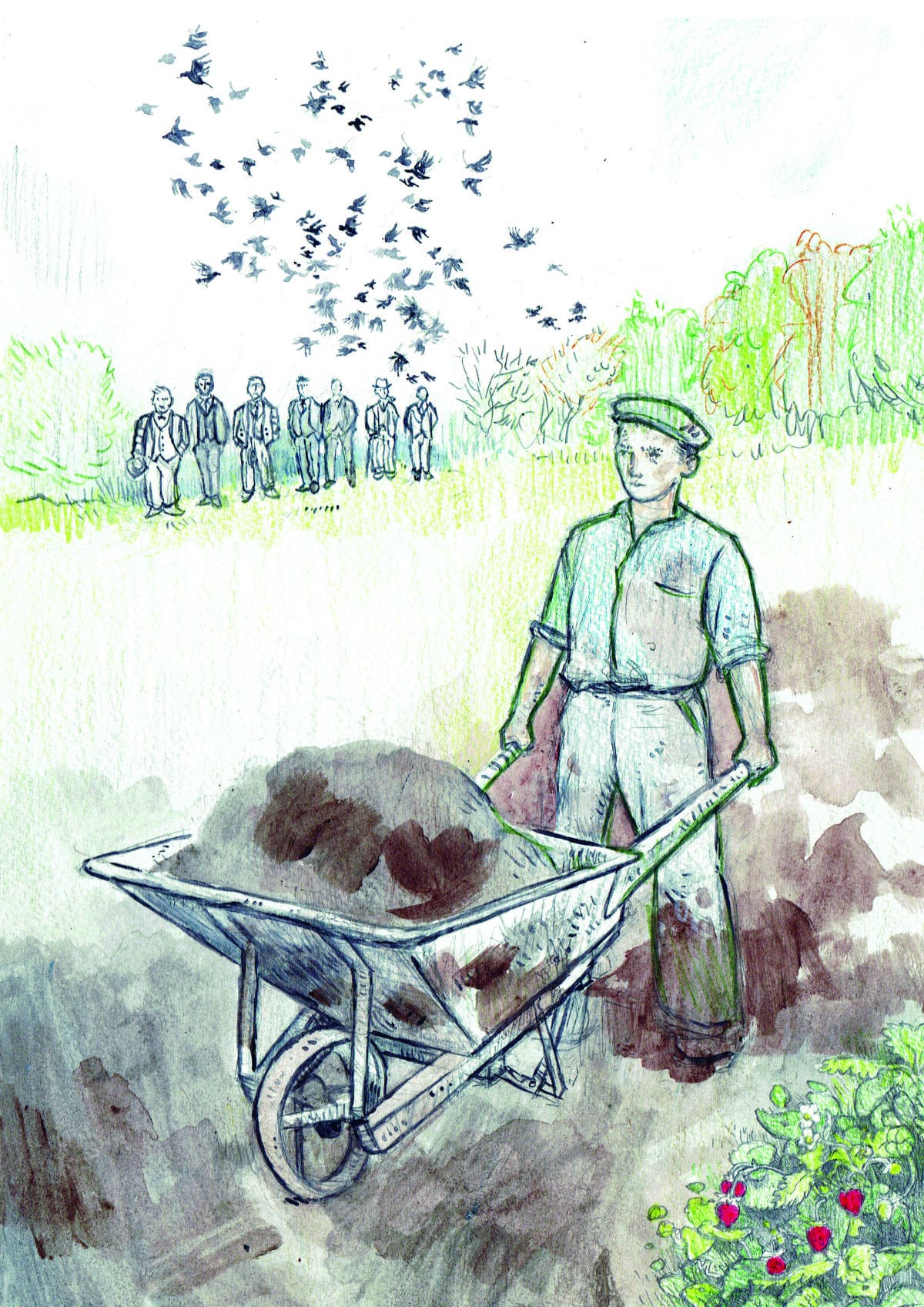
The loch at Drumpellier Park is normally a serene and lovely spot, surrounded by well-kept lawns, little forest glades, and all manner of flowers and birds. Jackie and his missus, Kate, would come here for picnics during the holiday fair fortnight. They picked wild strawberries straight from the plants and ate them with cream - a tonic after the war. They even went on the ‘boating loch’ once but kept getting stuck in the weeds.
Usually it’s lovely, but now, well, they call it an ‘archaeological dig’ but Jackie would rename it ‘a horrendous slop’. He’s got a few more names for this job, but none are appropriate for this book, never mind the high heid yins of Lanarkshire County Council who are paying him. In order to excavate for Iron Age archaeology, the loch has been partially dammed, the water held back by wooden frames and leaky sandbags, meaning the loch bed has become sludge, sludge, and more sludge, and Jackie has been employed to shift it. Don’t get him wrong, he is grateful for the employment. Not all men are so lucky in these times, but this is truly filthy work.
“That’s your barra full, Jackie!” the mud-covered boy bellows from below, wiping his red eyes and smearing fresh sludge onto his already-caked face. Jackie thinks the boy looks like a swamp monster down in that pit and realises he must look much the same.
“Fine”, Jackie grunts as he picks up the handles of his wheelbarrow and begins to wobble his way back to shore along slippery planks. He’s too old for this. His worn leather work boots, once proudly polished, are now weighing him down, stiff and encrusted with layers of muck. He imagines that if he cut through his boots, you’d see rings like the inside of a tree, each filthy layer another rotten day on this job. He should scrub the leather, but he’s given up trying to keep anything clean. His missus is having kittens; she’s making him strip off in the street before he’s allowed back into the close. The good people of Coatbridge will soon be lining up to watch!
Jackie sets down his loaded wheelbarrow and shakes off his aching wrist, an old war injury giving him jip. He sees the bosses on the loch bank. Their smart dark jackets make them look like giant crows on a churned-up field of grain, picking at the objects in the mud. They squawk a language of significance and importance, their words fluttering above the workers’ heads.“Those crows talk about us, not to us,” Jackie murmurs to himself. “Us swamp monsters and the crows up there are from different worlds, I suppose.”
He is about to lift the wheelbarrow handles again when he spots it: a round wedge of wood. He picks it out, wipes it on his once-white shirt and examines it between his thumb and forefinger. It's 6 inches long, with chisel marks around the circumference. He drops it in his overall pocket and pushes the barrow of mud to shore.
The sun has come out in time for lunch, so Jackie decides to rest on the grass and enjoy the food prepared by his wife - a well-fired roll and ham, an apple, some sweet oatcakes, and a boiled egg, which he picks up and peels, imagining what his wife would say about the dirt under his fingernails.
Ludovic McLellan Mann, an archaeologist and the dig’s head ‘crow’, hops over to Jackie’s chosen quiet, sunny spot.
“Some job you’re doing out there, old boy,” Mann grins, his small round glasses making him look even more bird-like. “How’s the water management system holding up?” Jackie observes him, careful not to misspeak in case he lands himself in more dirt.
“It’s holding, sir, but… it’s Scotland, the water will always find a way in.”
“Quite true!” Mann laughs.
Jackie hesitates, then pulls the wooden object from his pocket, holding it in the flat of his palm. “Found this in a barra load earlier.”
Mann’s beady eyes narrow. “May I?” Mann delicately picks up the object, squats at the edge of the loch and gently cleans the wood. “I think this could be an iron age object, old boy, but what it is, I couldn’t say, we’d need a real expert to tell us that.”
“It’s a framing peg, a dowel for a roof truss. It’s those pieces that hold whole buildings together. You can see the chisel marks where it’s been carved to size.”
Mann holds up the peg, so the sunlight catches the detail. “Oh my, I think I see now, old boy! Well, well, an expert among us, who’d have thought? It’s a fine discovery!” Beaming, Mann shakes Jackie’s hand, flinching only a little at the grime.
“I say, has anyone shown you yesterday’s find?”
Jackie shakes his head, and Mann flaps off enthusiastically, returning swiftly with a box. Nestled inside on a bed of straw, another piece of wood? No.
“A bone?” Jackie wagers.
“Quite so!” beams Mann, giving a little bounce. “Good eyes you’ve got. An arm bone, but more than that, you see this?” His long, clean finger hovers over a dark line the width of a cotton thread. “A perfectly healed fracture. At some point in this person’s life their injury was treated with care and expertise. The arm must have been in a splint for weeks or even months!”
Jackie thinks of his wife Kate, spoon-feeding him broth when he’d come back from the Front, then holding his head like a wean as he sobbed, finally realising he was safe.
“These people had community, healthcare, appreciation of beauty and a well-engineered home.” Mann holds up the peg. “In many ways, they were very much like us.”
From the shore, Jackie imagines the structure which stood in the loch thousands of years before - a crannog, round like the island it stood on. It would have been made of wood and thatched with dry reeds - that’s what he would have used anyway, plenty of those materials around here, the pine trees, the brush, a chimney at the heart, a home.
The sun stays with them after lunch, the warmth easing the ache in Jackie’s wrist and drying the mud on the planks, helping with grip as he manoeuvres his way to the dig site. He is in the pit this afternoon, filling other boys’ barrras. It is monotonous work, but there is something about the rhythm of it that feels good. He is strong; there is gentle sun and soft breeze on his skin, he is well fed and cared for - a contented creature of the swamp.
He imagines the people living on this loch. He can see their lives playing out around him: a pot of stew on the boil, children playing with yapping puppies on the banks, and workers like him digging, chiselling, lifting, measuring, caring, designing. Not suited crows, people who get their hands dirty, like him.