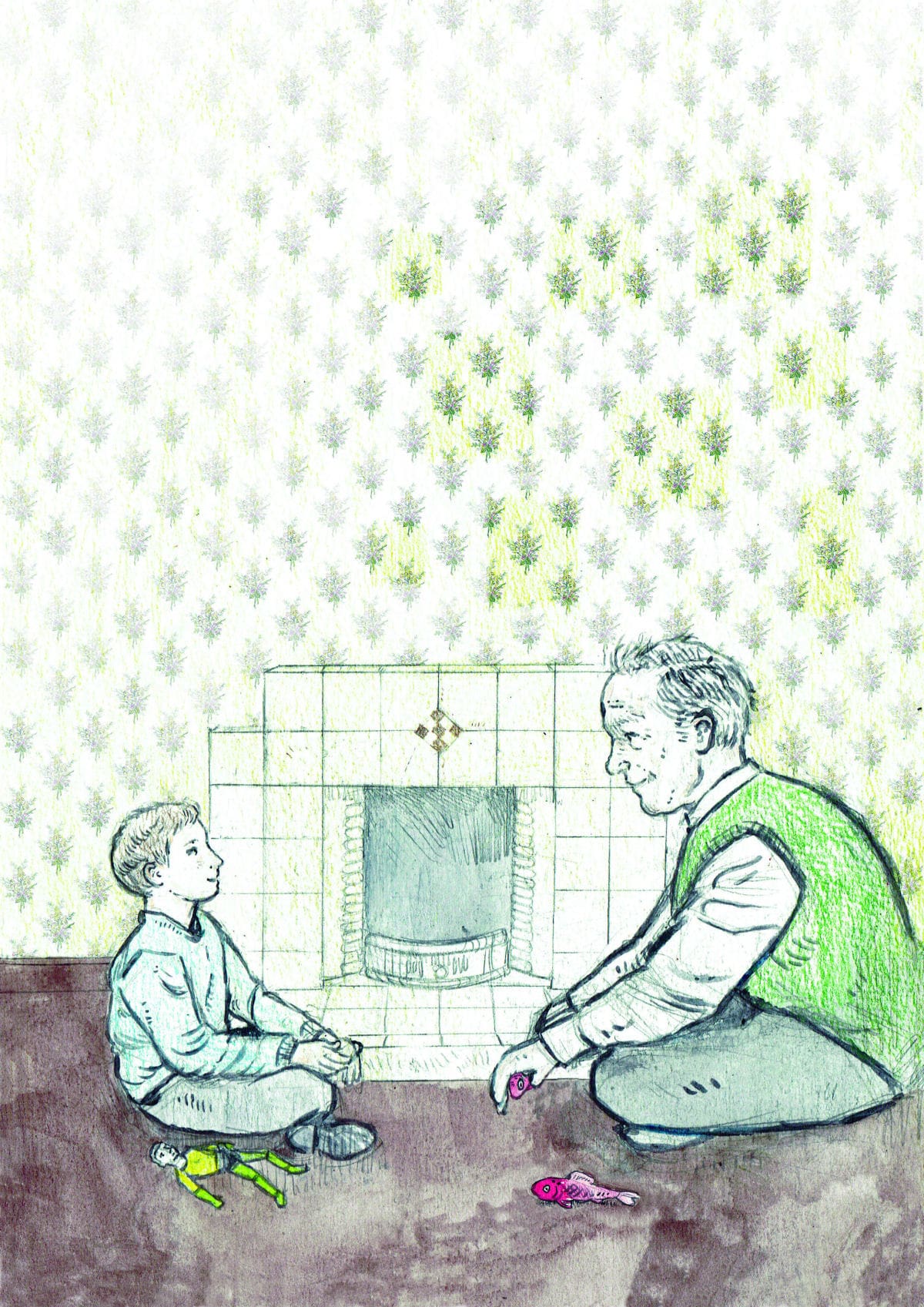
Jimmy dried the iron skillet, still warm from frying his family's breakfast eggs. He turned to hang it on the hook by the cooker but, paused, remembering it couldn’t go back there; it needed to go in the cardboard box his daughter, Margaret, had labelled ‘Kitchen’.
With a sigh, he nestled the skillet into the box among the rest of his kitchenware, each item telling stories: His wife May’s favourite spoon, the wood worn by her hand, their wedding china, the ceramic fish-shaped salt and pepper shakers they'd picked up in Blackpool in 1951,15 years ago. Time flies.
He saw his wife everywhere in this bare kitchen - at the stove, cup of tea in hand, at the table, chatting to the bairns, shouting at him to hang that blasted wallpaper straight, as he tried to match-up the lily flowers in the complicated pattern. They had bought the wallpaper from Lewis's Department Store as newlyweds, it had cost them an arm and a leg, but May wouldn’t have any other. Now it was faded but clinging on, much like him.
Soon the boys would load his packed memories into a van and take them to a new house in Bellshill with central heating and an inside toilet, and this place would be torn down with the rest of the village.
Bothwellhaugh, known as ‘the Pailis’ to locals, wasn’t posh, but it had character. Mining folks were community minded, hardworking and quick-tongued. From the corner shop to the churches, everyone knew everyone. You couldn’t walk down the street without a friendly nod or more likely a cheeky remark. But with the mines closed, the village had been dying for some time, its heart had disappeared and so the council had a grand plan, to flood it, literally divert the River Clyde to create a boating loch and new country park like no other. All that would be left were memories.
Robbie, his grandson, had pulled the little ceramic fish out of the box.
“No, Robbie, you can’t play with those. They’re precious,” Jimmy said sharply. Robbie’s hands trembled, not used to his Papa's sudden sternness.
“But all my toys are packed up!” Robbie’s voice wavered as he clutched the fish.
Jimmy’s face tightened as he snatched the salt and pepper shakers from Robbie’s grasp. “No means no,” his tone was even harsher. Robbie’s face fell and he stared at his empty hands.
“Stop squabbling, you two. It’s a big day for all of us,” Margaret called, confidently waddling from the bedroom to the kitchen, her baby bump leading the way, pressing against the fabric of her kaleidoscopic shift dress. “Look who I found, Robbie,” she said, her voice a soothing balm as she held out a six-inch green and yellow plastic figurine.
“Aquaman!” he exclaimed; his sorrow forgotten in an instant.
“Why don’t you and Aquaman colour in on the boxes?” she suggested, pulling out a little tin of crayons. Then, turning to her father, she added, “The van will be here any minute.”
Jimmy knew she was really saying it was time to say goodbye. He moved through the small house, absorbing every detail, from corner cupboards to the dark marks around the backyard tap where he had scrubbed coal dust off his hands. The coal dust never really left; it had melted into his skin. He’d had black eyebrows for three months after retiring, a badge of honour from his pit days.
He left the bedroom until last. Their haven. Memories in every scuffed floorboard. He saw May, getting dolled up at the dresser for dances down at the institute. Their bed, the best in the world according to May, was gone to the Salvation Army, the foot marks still in the carpet. That’s where he slept like a hibernating bear after pit shifts, and it was where Margaret and the boys were born.
On the floor, in the corner, his newspapers had been left crumpled in a heap. He hurried over, picked them up, and began flattening and restacking them in the right order.
"Dad, really? Do you really need to bring old newspapers?" Margaret stood in the doorway.
"History, Margaret," Jimmy grumbled. "I might need to remember something."
"A shilling says you never open them again," she chuckled.
"This isn't funny, Margaret!" Jimmy snapped, shoving a newspaper at her. "See this? This is how we learned about the Pailis, about our home! No meeting in the institute, not the decency to chap on the door and tell us face to face, that they are throwing us out and turning our village into a loch. No - we had to read about it on page 13!"
Through the doorway, he caught sight of streaks of bright colours. Robbie had drawn with garish waxy colours, over every inch he could reach of the kitchen’s lily wallpaper—red, blue, green—he had gone to town.
“Robbie, No! How dare you!” His voice was sharp, each word a lash. “Do you know how much that cost? How much she loved that?” He yanked the crayons from Robbie's little fingers and threw them on the floor. Robbie's eyes widened with shock before they filled with tears. He let out a wail and bolted out the back door, his small body shaking with sobs.
The room fell silent, the air thick with tension. Margaret's eyes burned into her father, but Jimmy didn’t look up, his neck was tingling hot with shame. Margaret moved towards him, her steps deliberate and calm. She cupped his cheek, in her hands, lifting it, forcing him to look at her, then she wrapped him in an all-enveloping hug, both comforting and confronting.
After a moment, she whispered, "You owe my son an apology. Go explain why you’re being such a miserable old mackerel."
Jimmy nodded, drew a shaky breath, and headed out back. He found Robbie squatting on the green out the back, his small arms wrapped around his scrawny bare knees, clutching Aquaman by his green boots.
"Robbie," Jimmy coaxed gently, but the wee boy shuffled a few inches away.
"Papa’s, so sorry. Moving out of here is very hard for me, you see. It's got my whole life's memories in it."
Robbie snapped his head up, eyes filled with a mixture of hurt and defiance. "It's got my whole life's memories too!" he retorted, then buried his face back in his knees.
Jimmy's heart ached; he understood it too well; this was the only home either of them had ever known. "You're right, pal. I'm being a selfish, mean old mackerel," Jimmy admitted.
Robbie mumbled into his knees, "Stinky mackerel," the faintest hint of a smile on his lips.
Jimmy kneeled, bringing himself to Robbie's level. From his pocket, he carefully pulled out one of the small, ceramic fish. "I think Aquaman needs a stinky mackerel mate," he said softly. "But this isn’t a toy, Robbie. It’s a precious memory of your gran and our life together. Can you keep it safe for me?"
Robbie’s tear-streaked cheeks glistened as he looked up and nodded seriously. "Is it true the Pailis will be underwater? So the fish will swim around the house rows and in my classroom?"
Jimmy smiled at the image and the innocence in Robbie's question. "Yes," he said gently. "The council decided that Aquaman needed a new home, and that wee boys and girls and grumpy old Papa’s needed a huge park to play in and make new memories."
Robbie looked at the ceramic fish in his hand, his grip firm. "I’ll keep it safe, Papa," he whispered. Jimmy smiled, and offered his hand, "Now, how about we have one last wander around the rows before the boys get here with the van?"